Whisky vs Wine: Systematic Review with ☸️SAIMSARA.


DOI: 10.62487/saimsarab2bb44ca

saimsara.com Download PDF

Review Stats
Identification of studies via EPMC (titles/abstracts) Identification Screening Included Records identified:n=146Records excluded:n=0 Records assessed for eligibilityn=146Records excluded:n=63 Studies included in reviewn=83 PRISMA Diagram generated by ☸️ SAIMSARA
⛛OSMA Triangle Head-to-Head (A vs B) Whisky vs Wine — Outcome Legend: “Favours Whisky” = left edge, “Favours Wine” = right edge; “Neutral” = vertical. Favours Whisky ΣN=32 (0%) Favours Wine ΣN=2575 (5%) Neutral ΣN=50236 (95%) 0 ⛛OSMA Triangle generated by ☸️SAIMSARA
Outcome-Sentiment Meta-Analysis (OSMA): (LLM-only)
Frame: Head-to-Head (A vs B) • Source: Europe PMC
Comparators: A = Whisky; B = Wine
Outcome: Outcome Typical timepoints: 15-day, 6-y. Reported metrics: %, CI, p.
Common endpoints: Common endpoints: alcoholic beverages, red wine, whisky lactone.
Predictor: Whisky vs Wine — exposure/predictor. Doses/units seen: 9.90 µg.


1) Introduction
Whisky and wine represent two distinct categories of alcoholic beverages, each with unique production methods, chemical compositions, and consumption patterns. Whisky, a distilled spirit typically aged in oak barrels, is known for its complex aromatic profile and higher ethanol content. Wine, a fermented beverage primarily from grapes, also benefits from oak aging in many varieties, developing characteristic sensory attributes. Beyond their sensory differences, these beverages are implicated in diverse physiological responses, health outcomes, and socio-economic dynamics. Understanding the comparative impacts of whisky and wine is crucial for public health, consumer science, and the beverage industry, necessitating a structured review of existing scientific literature.

2) Aim
The aim of this paper is to synthesize current research comparing whisky and wine across chemical, physiological, health, and socio-economic dimensions, identifying key distinctions and areas requiring further investigation.

3) Methods
Systematic review with multilayer AI research agent: keyword normalization, retrieval & structuring, and paper synthesis (see SAIMSARA About section for details).


4) Results
4.1 Study characteristics:
The review encompassed a broad range of study designs, including numerous "Mixed" studies, alongside Randomized Controlled Trials (RCTs), Cohort studies, and Cross-sectional analyses. Populations and settings were highly diverse, ranging from healthy human volunteers and specific national cohorts (e.g., Korean adults, Japanese men) to in vitro models (e.g., Escherichia coli, rat pancreatic acinar cells), and analyses of beverage samples themselves. Follow-up periods varied significantly, with many studies not specifying a duration ("N/A"), while others ranged from acute observations (e.g., 30 minutes to 48 hours) to long-term assessments (e.g., 10 years for wine aging, 2.6 years for health outcomes).

4.2 Main numerical result aligned to the query:
Whisky and wine exhibit distinct economic responses to price changes, with wine demonstrating a higher price elasticity (-0.955) compared to whisky (-0.587) in Taiwan, indicating greater sensitivity of wine consumption to price fluctuations [23]. Physiologically, the impact on gastric emptying shows conflicting results: one study indicated whisky did not significantly prolong gastric emptying times compared to equivalent ethanol concentrations, whereas red wine did [36], while another suggested whisky caused a significant slowdown of gastric emptying with magnitude increasing in the order of beer, red wine, and whisky [19]. Furthermore, whisky caused greater superficial staining and color change (ΔE) in a nanofilled composite resin compared to red wine, which showed statistically lower ΔE values [29].

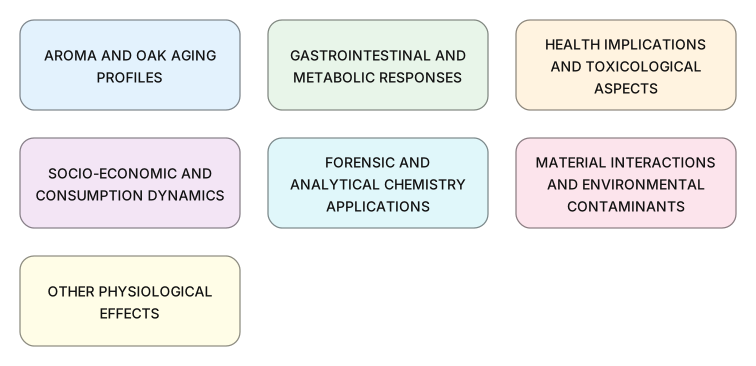
4.3 Topic synthesis:


5) Discussion
5.1 Principal finding:
In economic terms, wine demonstrates a higher price elasticity (-0.955) compared to whisky (-0.587) in Taiwan, indicating that wine consumption is more sensitive to price fluctuations than whisky consumption [23].

5.2 Clinical implications:


5.3 Research implications / key gaps:


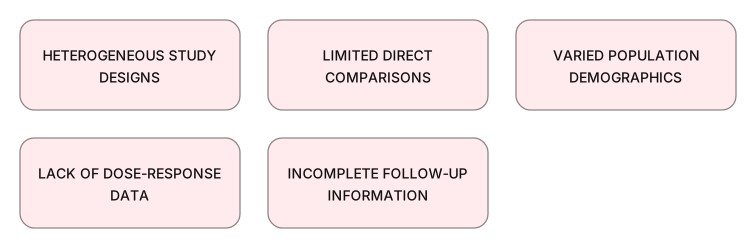
5.4 Limitations:


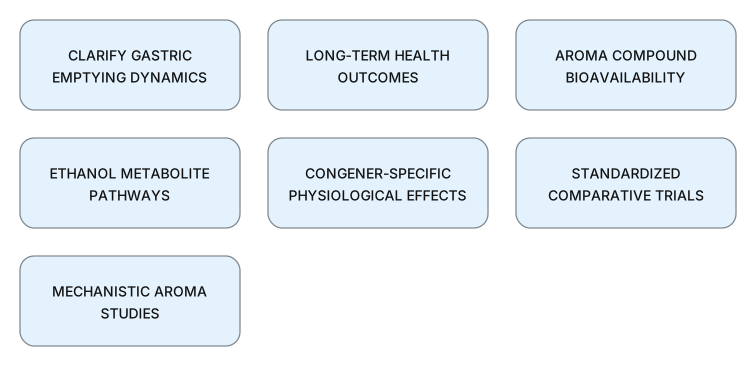
5.5 Future directions:


6) Conclusion
Whisky and wine exhibit distinct economic responses to price changes, with wine demonstrating a higher price elasticity (-0.955) compared to whisky (-0.587) in Taiwan, indicating greater sensitivity of wine consumption to price fluctuations [23]. These findings, drawn from diverse research settings including human physiological studies, chemical analyses, and socio-economic evaluations, highlight varied impacts across health, sensory, and economic domains. However, the heterogeneity in study designs and the scarcity of direct comparative data across identical metrics significantly limit the certainty of comprehensive conclusions. Future research should prioritize standardized comparative studies to elucidate the full spectrum of differential effects of whisky versus wine on human health and behavior.

References
SAIMSARA Session Index — session.json

Figure 1. Publication-year distribution of included originals

Figure 2. Study-design distribution of included originals
Figure 2. Study-design distribution

Figure 3. Study-type (directionality) distribution of included originals
Figure 3. Directionality distribution

Figure 4. Main extracted research topics
Figure 4. Main extracted research topics (Results)

Figure 5. Limitations of current studies (topics)

Figure 6. Future research directions (topics)