
SAIMSARA Journal

Machine Generated Science • ISSN 3054-3991

Apixaban vs Rivaroxaban: Scoping Review with ☸️SAIMSARA.

Cardiac & Vascular Health icon

Cardiac & Vascular Health

Issue 1, Volume 1, 2026

DOI: 10.62487/saimsarae6ee9492

Editorial note
• Last update: 2026-05-05 20:55:09
What is this paper about
This review maps 995 original studies and 26.6 million participants comparing apixaban and rivaroxaban across AF, VTE, CKD, cirrhosis, cancer, elderly, and other high-risk populations. It delivers a clear human- and machine-ready signal: apixaban shows a more favorable bleeding profile, while rivaroxaban remains relevant in selected adherence, cost, VTE, and orthopedic contexts.
Human-verified editorial review Verified by World ID proof-of-human. This editorial layer was submitted from a SAIMSARA account verified as a unique human.


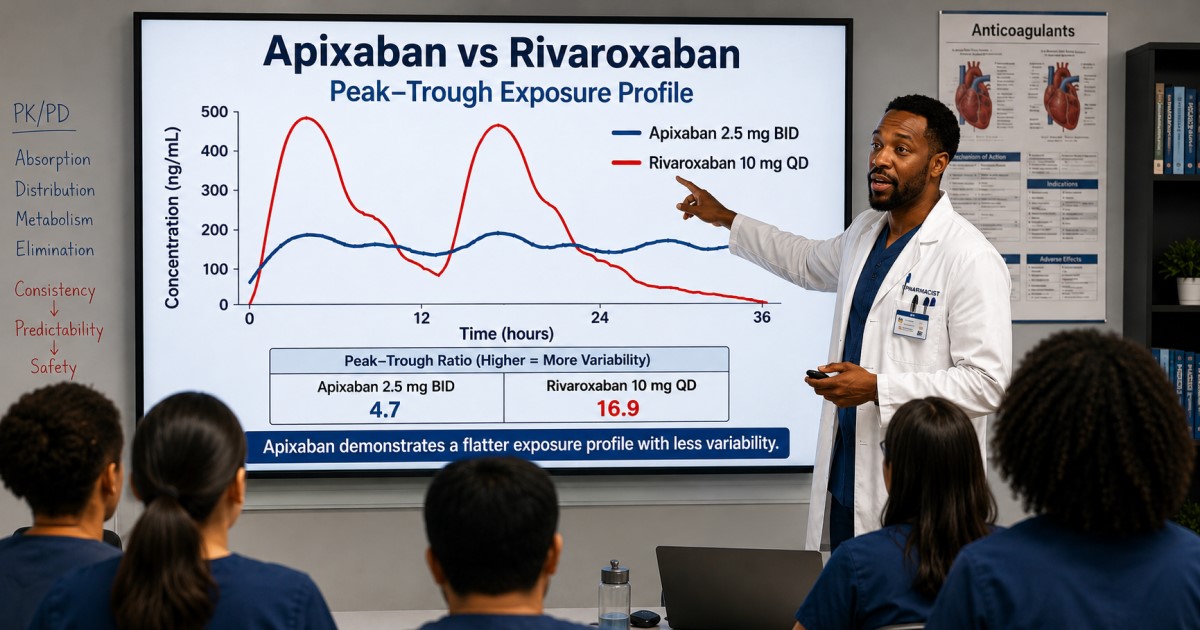
Abstract: This review aims to synthesize current evidence comparing apixaban and rivaroxaban regarding clinical effectiveness, safety outcomes (specifically bleeding risks), and pharmacological performance across diverse patient populations and clinical scenarios. The review utilises 995 original studies with 26655215 total participants (topic deduplicated ΣN). Across the mapped evidence, apixaban emerged as the agent with a more favorable bleeding profile compared with rivaroxaban, with hazard ratios for major bleeding ranging from 0.50 to 0.86 and for gastrointestinal bleeding from 0.33 to 0.72, while effectiveness for stroke and recurrent VTE prevention was largely comparable. This signal was consistent across diverse clinical contexts including advanced CKD, cirrhosis, diabetes, valvular heart disease, HIV, peripheral artery disease, and the very elderly, and was reinforced by pharmacokinetic observations of more stable apixaban exposure (peak-to-trough ratio 4.7 vs 16.9) and by pharmacovigilance signals favoring apixaban for hematuria, uterine bleeding, and hepatic injury. Notable countervailing signals included occasional VTE readmission and mortality findings favoring rivaroxaban, mixed endoscopic and orthopedic results, and adherence data sometimes favoring once-daily rivaroxaban, indicating that the choice between agents is not uniformly directional. The clinical implication supported by this evidence map is that apixaban may be preferentially considered in patients with elevated bleeding risk, renal or hepatic impairment, or concomitant antiplatelet therapy, while recognizing that channeling bias and the predominance of observational data temper certainty. Future research should prioritize randomized head-to-head comparisons in cirrhosis, advanced CKD, cancer-associated VTE, and women with heavy menstrual bleeding, alongside refined dosing and monitoring protocols for patients with bariatric surgery, antiseizure medication co-therapy, or extreme body weight.

Keywords: Apixaban; Rivaroxaban; Atrial Fibrillation; Venous Thromboembolism; Major Bleeding Risk; Ischemic Stroke; Gastrointestinal Bleeding; Direct Oral Anticoagulants; Comparative Effectiveness; Factor Xa Inhibitors

Review Stats

Get access to the full paper

Unlock the full evidence map

The full evidence review, including the Introduction, Methods, Results, Discussion, Conclusion, figures, and complete reference index, opens after purchase or sign-in. The Evidence Object JSON is a separate machine-readable evidence product: a concentrated synthesis of results, topic-level evidence, and discussion across original and non-original studies. It can be directly input into your LLM, agent, or RAG workflow.

Reference Index (177)