
SAIMSARA Journal

Machine Generated Science • ISSN 3054-3991

Renal Artery Stenosis: Scoping Review with ☸️SAIMSARA.

Cardiac & Vascular Health icon

Cardiac & Vascular Health

Issue 1, Volume 1, 2026

DOI: 10.62487/saimsaradd7acfef

Editorial note
• Last update: 2026-05-10 19:04:05
What is this paper about
Renal artery stenosis is not a simple “stent or no stent” disease: this map separates broad neutral randomized evidence from the high-risk phenotypes where revascularization may still matter. The full SAIMSARA evidence map gives clinicians and AI agents a structured, reference-linked view of prevalence, imaging accuracy, medical therapy, physiology-guided selection, transplant/pediatric RAS, and remaining gaps.
Human-verified editorial review Verified by World ID proof-of-human. This editorial layer was submitted from a SAIMSARA account verified as a unique human.


Evidence preview · Did you know?
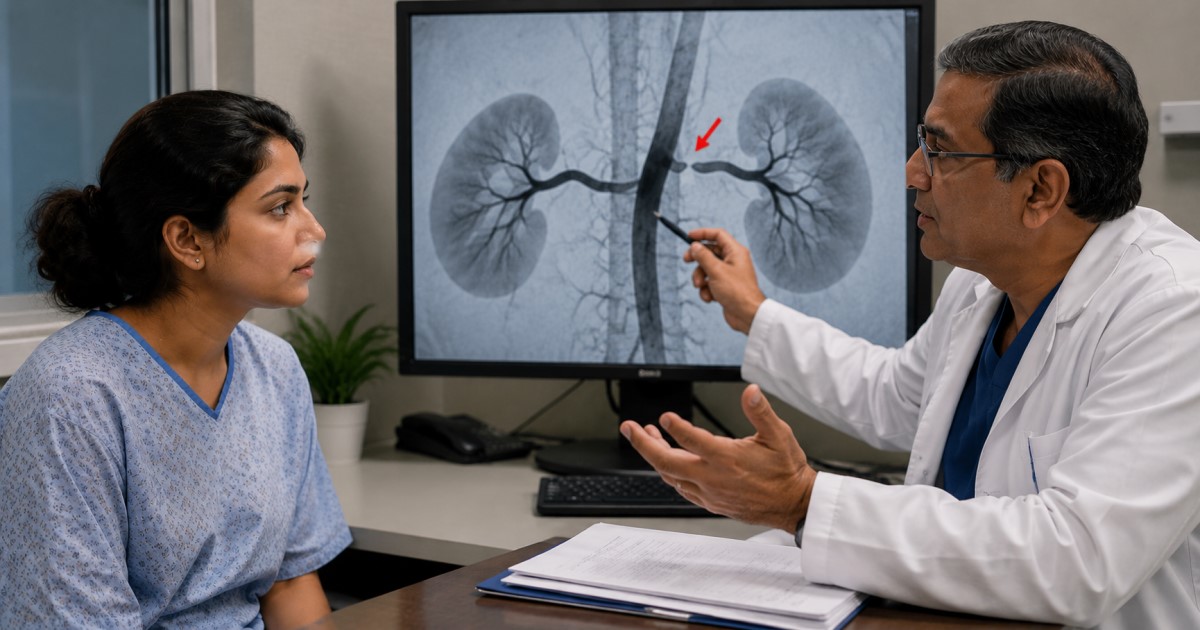
Realistic medical scene showing renal artery stenosis as part of systemic vascular disease.

A kidney artery finding can reveal whole-body risk

Did you know? Renal artery stenosis was found in 9.7%–18.2% of coronary angiography patients and up to 20% of PAD patients.

This makes it less an isolated renal lesion and more a marker of diffuse atherosclerosis.

Realistic vascular medicine scene showing decision-making between renal artery stenting and medical therapy.

The stent story is more surprising than expected

Did you know? Large trials such as ASTRAL and CORAL found no major outcome benefit from routine renal artery stenting over medical therapy.

The evidence map separates anatomical narrowing from outcomes that actually change patient prognosis.

Realistic emergency vascular-care scene representing high-risk renal artery stenosis phenotypes.

Neutral trials do not mean “never intervene”

Did you know? Revascularization remains critical for selected high-risk phenotypes: flash pulmonary edema, solitary kidney decline, or bilateral severe stenosis.

This is the clinical danger zone where phenotype selection matters more than routine stenting logic.

Swipe sideways on mobile · full evidence map opens after unlock

Abstract: The aim of this paper is to synthesize the current evidence regarding the prevalence, diagnostic accuracy of imaging modalities, pathophysiology, and therapeutic outcomes of renal artery stenosis across diverse patient populations, including pediatric, transplant, and atherosclerotic cohorts. The review utilises 3237 original studies with 1629628 total participants (topic deduplicated ΣN). The mapped evidence indicates that renal artery stenosis is best understood as a marker of systemic atherosclerosis, identified in 9.7%–18.2% of coronary angiography cohorts and up to 20% of peripheral arterial disease populations, with a community prevalence of atherosclerotic disease around 4.8% and renal artery plaque in 28.7% of older adults. Across the dominant topic clusters, randomized evidence from ASTRAL and CORAL supports optimized medical therapy as the default strategy, while revascularization signals were most consistent in selected high-risk phenotypes such as flash pulmonary edema, bilateral or solitary-kidney disease, and rapidly declining renal function. Diagnostic synthesis suggests that duplex ultrasound, contrast-enhanced ultrasound, CT angiography, and noncontrast MR angiography provide complementary noninvasive assessment, with CEUS showing high diagnostic performance across cohorts, and that hemodynamic indices such as hyperemic gradients >21 mm Hg and renal fractional flow reserve may refine patient selection beyond anatomic narrowing. Recurrent signals across transplant, pediatric, Takayasu, fibromuscular dysplasia, and neurofibromatosis cohorts highlight the heterogeneity of underlying mechanisms and support phenotype-based management rather than uniform interventional thresholds. The mapped evidence is constrained by small median cohort sizes and heterogeneous definitions, so findings should be interpreted as evidence distribution rather than pooled effect. Future research should prioritize prospective validation of physiology-guided and machine-learning–based selection tools to identify the subset of patients in whom revascularization meaningfully alters renal and cardiovascular trajectories.

Keywords: Renovascular hypertension; Atherosclerotic renal artery stenosis; Duplex ultrasound; Contrast-enhanced ultrasound; Transplant renal artery stenosis; Fibromuscular dysplasia; Digital subtraction angiography; Surgical revascularization; Secondary hypertension; Magnetic resonance imaging

Review Stats

Get access to the full paper

Unlock the full evidence map

The full evidence review, including the Introduction, Methods, Results, Discussion, Conclusion, figures, and complete reference index, opens after purchase or sign-in. The Evidence Object JSON is a separate machine-readable evidence product: a concentrated synthesis of results, topic-level evidence, and discussion across original and non-original studies. It can be directly input into your LLM, agent, or RAG workflow.

Reference Index (271)