SAIMSARA Journal

Machine Generated Science • ISSN 3054-3991

Snuffbox Arteriovenous Fistula for Hemodialysis: Scoping Review with ☸️SAIMSARA.

Cardiac & Vascular Health icon

Cardiac & Vascular Health

Issue 1, Volume 1, 2026

DOI: 10.62487/saimsara785f8c8b

Editorial note
• Last update: 2026-05-15 11:24:03
What is this paper about
Snuffbox AVF emerges as a clinically credible distal-first hemodialysis access strategy, offering patency broadly comparable to wrist radiocephalic fistulas while preserving future access options. The full SAIMSARA evidence map is worth reading because it separates durable signals from selection-dependent outcomes, complications, reintervention needs, vessel-diameter thresholds, and long-term uncertainty across the available snuffbox fistula literature.
Human-verified editorial review Verified by World ID proof-of-human. This editorial layer was submitted from a SAIMSARA account verified as a unique human.

Evidence preview · Did you know?
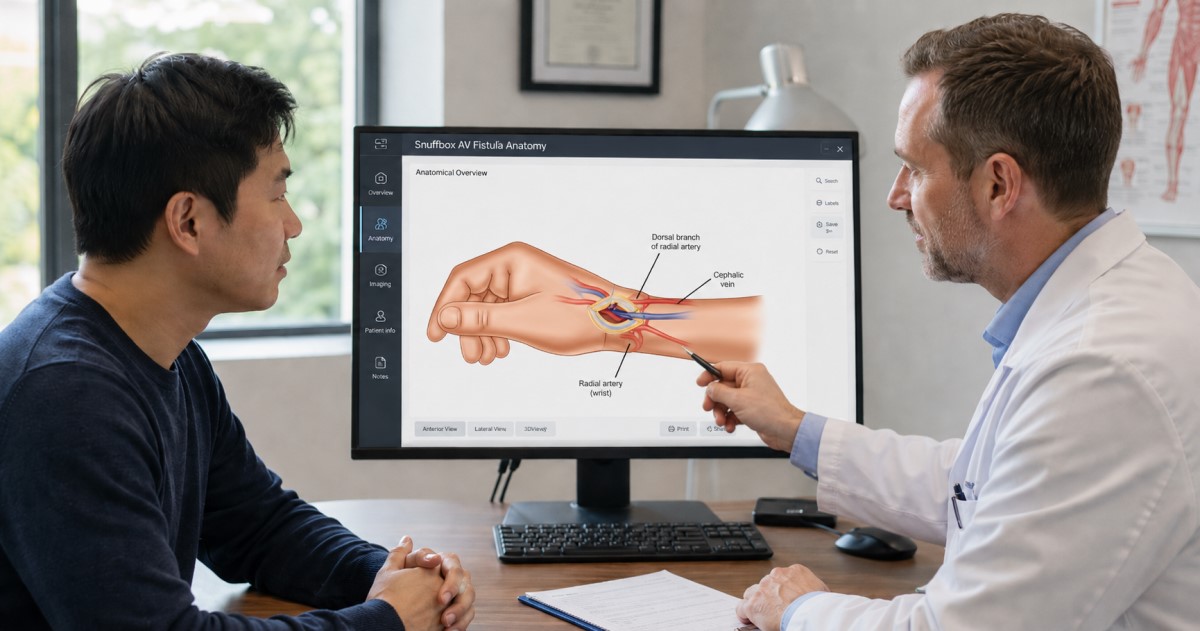
Visual-only medical scene showing distal snuffbox arteriovenous fistula planning for hemodialysis access.

A tiny distal site may preserve the future

Did you know? Snuffbox AVFs were repeatedly reported as broadly comparable to wrist radiocephalic fistulas while preserving more proximal access options.

That makes the snuffbox strategy clinically attractive when long-term dialysis access planning matters.


Visual-only comparison scene of snuffbox and wrist fistula outcomes with dialysis access mapping.

The comparison signal is closer than expected

Did you know? One randomized study reported maturation of 61% for snuffbox AVF versus 65% for wrist AVF, while VQI data showed 6-month primary patency of 51% versus 48%.

The evidence does not show a clear major disadvantage for snuffbox AVF in selected patients.

Visual-only ultrasound vessel mapping scene highlighting patient selection before snuffbox fistula creation.

Good anatomy may be the real gatekeeper

Did you know? Better outcomes were linked to younger, non-diabetic patients and vessel diameters above about 2.0–2.5 mm.

The full evidence map matters because snuffbox AVF success is highly selection-dependent, not universally guaranteed.

Swipe sideways on mobile · full evidence map opens after unlock

Abstract: To evaluate the clinical viability, patency rates, and complication profiles of snuffbox arteriovenous fistulas compared to conventional distal access sites for hemodialysis. The review uses 31 references and builds its evidence map from 39 original studies with 16056 total participants/sample observations (topic-deduplicated ΣN). Current evidence indicates that the snuffbox arteriovenous fistula is a viable first-line distal hemodialysis access, with maturation and patency broadly comparable to wrist radiocephalic fistulas and one-year primary patency reported between approximately 60.6% and 87%. The recurrent signal across cohorts supports a role for snuffbox access in preserving more proximal venous access options while maintaining acceptable safety, including low rates of ischemic steal. Optimal outcomes appear concentrated in younger, non-diabetic patients with adequate vessel caliber, highlighting the importance of preoperative selection and tools such as the DISTAL score. However, the evidence base remains dominated by retrospective single-center experience, which tempers certainty. Large multicenter randomized trials with follow-up beyond five years are needed to definitively establish long-term comparative durability against wrist access.

Keywords: Snuffbox arteriovenous fistula; Hemodialysis access; Primary patency; Radiocephalic fistula; Vascular access maturation; Anatomical snuffbox; End-stage kidney disease; Radial steal syndrome; Venous hypertension

Review Stats

Get access to the full paper

Unlock the full evidence map

The full evidence review, including the Introduction, Methods, Results, Discussion, Conclusion, figures, and complete reference index, opens after purchase or sign-in. The Evidence Object JSON is a separate machine-readable evidence product: a concentrated synthesis of results, topic-level evidence, and discussion across original and non-original studies. It can be directly input into your LLM, agent, or RAG workflow.

Reference Index (31)