SAIMSARA Journal

Machine Generated Science • ISSN 3054-3991

Superior Vena Cava Syndrome: Scoping Review with ☸️SAIMSARA.

Cardiac & Vascular Health icon

Cardiac & Vascular Health

Issue 1, Volume 1, 2026

DOI: 10.62487/saimsaraea077b6a

Editorial note
• Last update: 2026-05-12 20:39:15
What is this paper about
Superior vena cava syndrome is no longer only an oncologic emergency: this evidence map shows how malignancy, catheters, pacemaker leads, dialysis access, thrombosis, pediatric mediastinal tumors, and procedural risks converge in one clinically complex syndrome. The full SAIMSARA evidence map gives human- and machine-readable access to 1,185 original studies, clarifying when to prioritize tissue diagnosis, endovascular stenting, oncologic therapy, airway planning, or benign-disease venous reconstruction.
Human-verified editorial review Verified by World ID proof-of-human. This editorial layer was submitted from a SAIMSARA account verified as a unique human.

Evidence preview · Did you know?
Realistic hospital image showing urgent endovascular treatment planning for superior vena cava syndrome.

A blocked chest vein can be relieved fast

Did you know? In malignant SVCS, stenting reached technical success near 98–99%, symptom relief around 86–94%, and 12-month patency around 80–86%.

This makes SVCS a condition where rapid mechanical palliation may change the immediate clinical pathway.
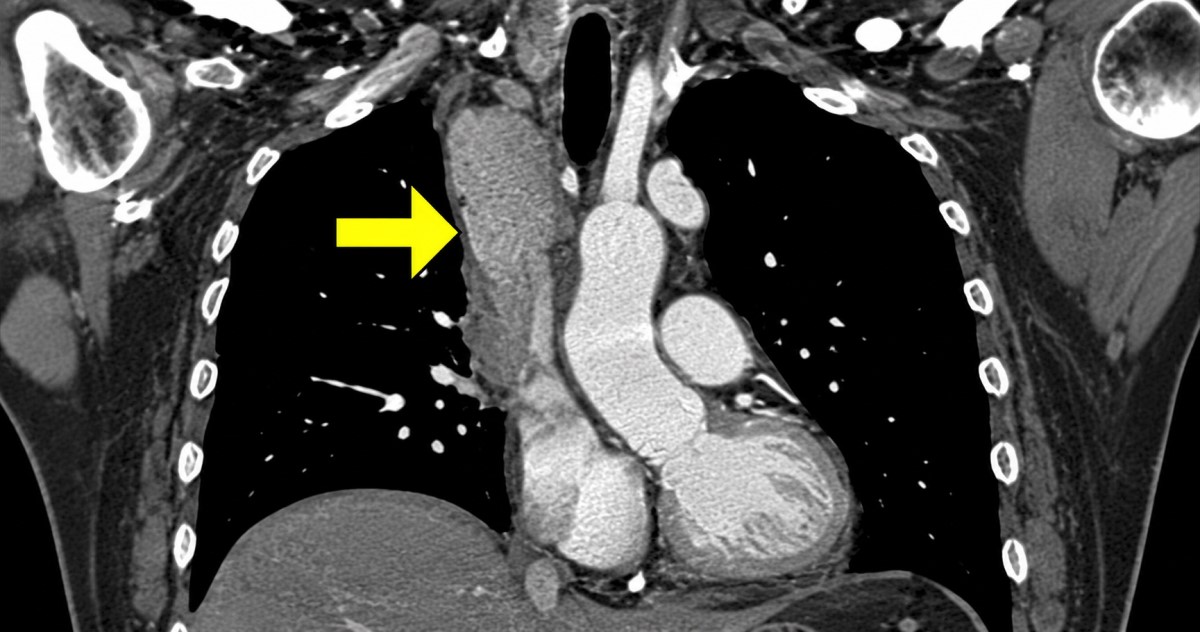

Realistic split clinical image suggesting lung cancer, mediastinal disease, catheters, pacemaker leads, and dialysis access.

Still cancer-dominant, but device-era SVCS is rising

Did you know? Adult SVCS was malignancy-related in 60% to 90.1% of cases, but one benign SVCS cohort found 71% caused by intravascular devices.

The evidence map captures both the classic cancer emergency and the modern catheter, pacemaker, and dialysis-access problem.

Realistic pediatric hospital and airway-planning scene for a mediastinal mass with superior vena cava syndrome risk.

In children, SVCS may mean airway danger

Did you know? SVCS was present in 25% of children admitted to PICU for emergency care due to mediastinal mass.

This turns pediatric SVCS into an oncology, anesthesia, and airway-planning signal — not only a venous obstruction.

Swipe sideways on mobile · full evidence map opens after unlock

Abstract: To scope and synthesize original research on SVCS, emphasizing recurring etiologic patterns, diagnostic pathways, treatment strategies, procedural risks, special populations, and clinically actionable implications. The review uses 200 references and builds its evidence map from 1185 original studies with 573425 total participants (topic-deduplicated ΣN). This scoping review indicates that SVCS remains predominantly a malignancy-associated syndrome in adults—especially lung cancer and mediastinal lymphoma—while benign device-, catheter-, and lead-related causes are an increasingly recognized modern mechanism, accounting for 71% of benign cases in one cohort. Across the evidence, endovascular stenting emerged as the most consistent intervention signal, with technical success near 98–99% and symptomatic relief around 86–94% in large malignant SVCS cohorts, supporting a role for stenting as early palliation that can facilitate subsequent oncologic therapy. Pediatric presentations were tightly linked to lymphoid mediastinal malignancy and carried airway risk, highlighting the need for coordinated oncology, anesthesia, and airway planning. Given the predominance of retrospective and single-arm data, future prospective comparative studies with harmonized symptom, patency, and survival endpoints are needed to clarify the optimal sequencing of stenting, radiotherapy, and systemic therapy across etiologies.

Keywords: Superior vena cava syndrome; Mediastinal tumors; Venous obstruction; Malignancy; Central venous catheters; Thrombosis; Endovascular stenting; Mechanical thrombectomy; Collateral circulation; Computed tomography

Review Stats

Get access to the full paper

Unlock the full evidence map

The full evidence review, including the Introduction, Methods, Results, Discussion, Conclusion, figures, and complete reference index, opens after purchase or sign-in. The Evidence Object JSON is a separate machine-readable evidence product: a concentrated synthesis of results, topic-level evidence, and discussion across original and non-original studies. It can be directly input into your LLM, agent, or RAG workflow.

Reference Index (200)