SAIMSARA Journal

Machine Generated Science • ISSN 3054-3991

Thrombophlebitis and Complications: Systematic Review with ☸️SAIMSARA.

Vascular Health icon

Vascular Health

Issue 1, Volume 1, 2026

Editorial check • Last update: 2026-02-24
What was done
2026-02-24
Deduplicated references check Clinical & Methodological Validation
Found an error or inappropriate content? admin@saimsara.com


Download PDF (initial draft)

Abstract: This paper aims to synthesize the current evidence regarding the incidence, risk factors, associated conditions, and complications of thrombophlebitis, drawing exclusively from a structured extraction summary of scientific literature. The review utilises 42 studies with 37998 total participants (naïve ΣN). Thrombophlebitis represents a common and diverse complication across various clinical settings, with incidence rates for catheter-related events ranging widely from 0.4% to 87.1%. It is associated with a spectrum of severe complications, including deep vein thrombosis, pulmonary embolism, cerebral thrombophlebitis, septic shock, and increased mortality. Risk factors such as catheter characteristics, underlying conditions like Behcet's disease, and specific surgical procedures necessitate targeted prevention and management strategies. A key limitation is the heterogeneity in study designs and outcome definitions, underscoring the need for standardized diagnostic criteria and robust comparative effectiveness trials to optimize patient care and improve long-term outcomes.

Keywords: Thrombophlebitis; Superficial thrombophlebitis; Deep vein thrombosis; Pulmonary embolism; Catheter-related complications; Septic thrombophlebitis; Chronic venous insufficiency; Vascular access devices; Infectious complications; Varicose veins

Review Stats
Identification of studies via Semantic Scholar (all fields) Identification Screening Included Records identified:n=6156Records excluded:n=5156 Records assessed for eligibilityn=1000Records excluded:n=958 Studies included in reviewn=42 PRISMA Diagram generated by ☸️ SAIMSARA
⛛OSMA Triangle Effect-of Predictor → Outcome thrombophlebitis  →  complications Beneficial for patients ΣN=0 (0%) Harmful for patients ΣN=35873 (94%) Neutral ΣN=2125 (6%) 0 ⛛OSMA Triangle generated by ☸️SAIMSARA
Show OSMA legend
Outcome-Sentiment Meta-Analysis (OSMA): (LLM-only)
Frame: Effect-of Predictor → Outcome • Source: Semantic Scholar
Outcome: complications Typical timepoints: 7-day, 5-mo. Reported metrics: %, CI, p.
Common endpoints: Common endpoints: complications, mortality, recurrence.
Predictor: thrombophlebitis — exposure/predictor. Routes seen: iv. Typical comparator: piccs, 13.4, 6.88, those without thrombosis….

  • 1) Beneficial for patients — complications with thrombophlebitis — — — ΣN=0
  • 2) Harmful for patients — complications with thrombophlebitis — [1], [2], [3], [4], [5], [6], [8], [9], [10], [11], [12], [13], [15], [17], [18], [19], [20], [21], [22], [23], [25], [27], [28], [30], [33] — ΣN=35873
  • 3) No clear effect — complications with thrombophlebitis — [7], [14], [16], [24], [26], [29], [31], [32], [34], [35], [36], [37], [38], [39], [40], [41], [42] — ΣN=2125
1) Introduction
Thrombophlebitis, an inflammatory process causing a blood clot to form and block one or more veins, presents a significant clinical challenge across diverse patient populations. Its manifestations range from superficial venous inflammation to life-threatening deep vein thrombosis (DVT) and pulmonary embolism (PE). This condition is frequently associated with medical interventions such as peripheral and central venous catheterization, as well as underlying pathologies including varicose veins, infectious diseases, and systemic inflammatory conditions. Understanding the incidence, risk factors, and array of complications associated with thrombophlebitis is crucial for effective prevention and management strategies.

2) Aim
This paper aims to synthesize the current evidence regarding the incidence, risk factors, associated conditions, and complications of thrombophlebitis, drawing exclusively from a structured extraction summary of scientific literature.

3) Methods
Systematic review with multilayer AI research agent: keyword normalization, retrieval & structuring, and paper synthesis (see SAIMSARA About section for details).


4) Results
4.1 Study characteristics
The included studies encompassed a variety of designs, predominantly cohort studies [1], [2], [4], [5], [6], [8], [11], [14], [15], [17], [18], [19], [22], [27], [28], [32], [33], [36], [37], randomized controlled trials (RCTs) [3], [26], [40], [42], cross-sectional studies [7], [31], mixed designs [6], [16], [21], [25], [37], and retrospective analyses without specified design [9], [10], [12], [13], [23], [24], [29], [30], [34], [35], [38], [39], [41]. Populations studied included hospitalized patients in tertiary care settings, critically ill adults, patients with varicose veins, Behcet's disease, cancer, post-surgical patients, pregnant women, and pediatric cases. Follow-up periods varied from short-term (e.g., 1 month [18, 30 days [33], [42]) to several months (e.g., 6 months [2], 90 days [3]) or years (e.g., 1 to 8 years [7]).

4.2 Main numerical result aligned to the query
The incidence of thrombophlebitis varies significantly depending on the context and type of vascular access, ranging from 0.4% [41] to 87.1% [28] for catheter-related events. Specifically, thrombophlebitis developed in 10% of patients after peripheral venous cannulation [1] and in 6% of patients undergoing central venous catheterization [5]. For vasopressor administration, midlines were associated with a 5.2% frequency of superficial thrombophlebitis compared to 13.4% for peripherally inserted central catheters (PICCs) [4]. Catheter-related thrombosis, including superficial venous thrombophlebitis, was reported at 11.88% for midline catheters versus 6.88% for PICCs [6].

4.3 Topic synthesis


5) Discussion
5.1 Principal finding
The incidence of thrombophlebitis, particularly in catheter-related contexts, exhibits wide variability, with reported rates ranging from 0.4% [41] to 87.1% [28], underscoring its pervasive nature and significant association with severe complications such as deep vein thrombosis, pulmonary embolism, and mortality.

5.2 Clinical implications


5.3 Research implications / key gaps


5.4 Limitations


5.5 Future directions


6) Conclusion
Thrombophlebitis represents a common and diverse complication across various clinical settings, with incidence rates for catheter-related events ranging widely from 0.4% to 87.1%. It is associated with a spectrum of severe complications, including deep vein thrombosis, pulmonary embolism, cerebral thrombophlebitis, septic shock, and increased mortality. Risk factors such as catheter characteristics, underlying conditions like Behcet's disease, and specific surgical procedures necessitate targeted prevention and management strategies. A key limitation is the heterogeneity in study designs and outcome definitions, underscoring the need for standardized diagnostic criteria and robust comparative effectiveness trials to optimize patient care and improve long-term outcomes.

Session data (all downloaded records)
SAIMSARA Session Index — session.json

Figure 1. Publication-year distribution of included originals

Figure 2. Study-design distribution of included originals
Figure 2. Study-design distribution

Figure 3. Study-type (directionality) distribution of included originals
Figure 3. Directionality distribution

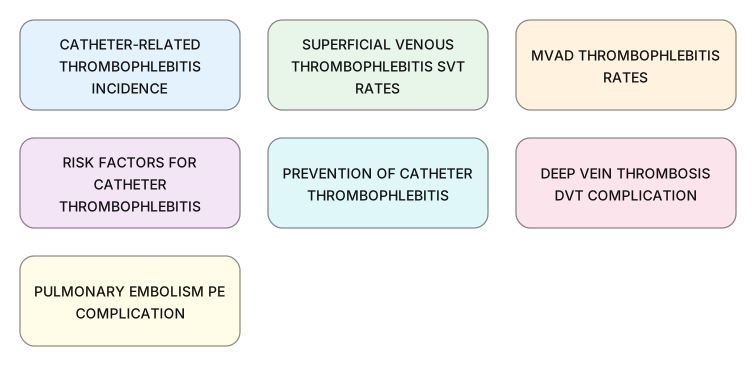
Figure 4. Main extracted research topics
Figure 4. Main extracted research topics (Results)

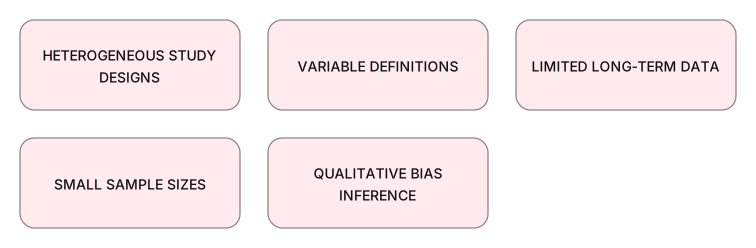
Figure 5. Limitations of current studies (topics)

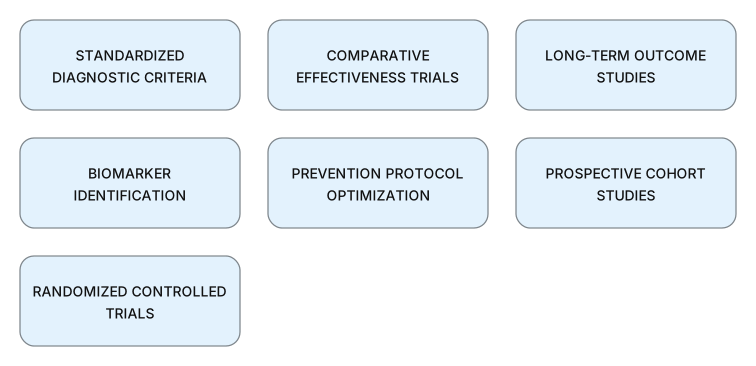
Figure 6. Future research directions (topics)
Reference Index (42)

Get access to the full paper

temporary link or permanent access.

The remaining part of the paper opens after purchase or unlock.