☸️SAIMSARA Journal
Online First Issues About Impressum

AI-Native Scoping Reviews & Evidence Mapping

ISSN 3054-3991 · ISSN record ↗
The Journal publishes machine-generated scoping reviews in medical and life sciences under human-editorial oversight, with transparent citations and versioning. Online First articles are continuously released by registered users. Issues are organized by domain and linked to an interactive AI RAG chatbot.
Editor's Choice papers are marked with .

Read aims & scope, publishing model & policies →

Issues

Domain issues provide a same-page filtered article view and a paired RAG agent.
Cardiac & Vascular Health icon
Cardiac & Vascular Health
Issue 1 • Vol 1 (2026) in progress

Longevity & Public Health icon
Longevity & Public Health
Issue 2 • Vol 1 (2026) in progress

Digital Health icon
Digital Health
Issue 3 • Vol 1 (2026) in progress
Mental Health icon
Mental Health
Issue 4 • Vol 1 (2026) in progress

Sports Medicine icon
Sports Medicine
Issue 5 • Vol 1 (2026) in progress
Pain Medicine icon
Pain Medicine
Issue 6 • Vol 1 (2026) in progress
Infectious Diseases icon
Infectious Diseases
Issue 7 • Vol 1 (2026) in progress
Skin & Aesthetics icon
Skin & Aesthetics
Issue 8 • Vol 1 (2026) in progress
To propose a new domain issue or suggest curation criteria, use Impressum contact.
Reset All issues
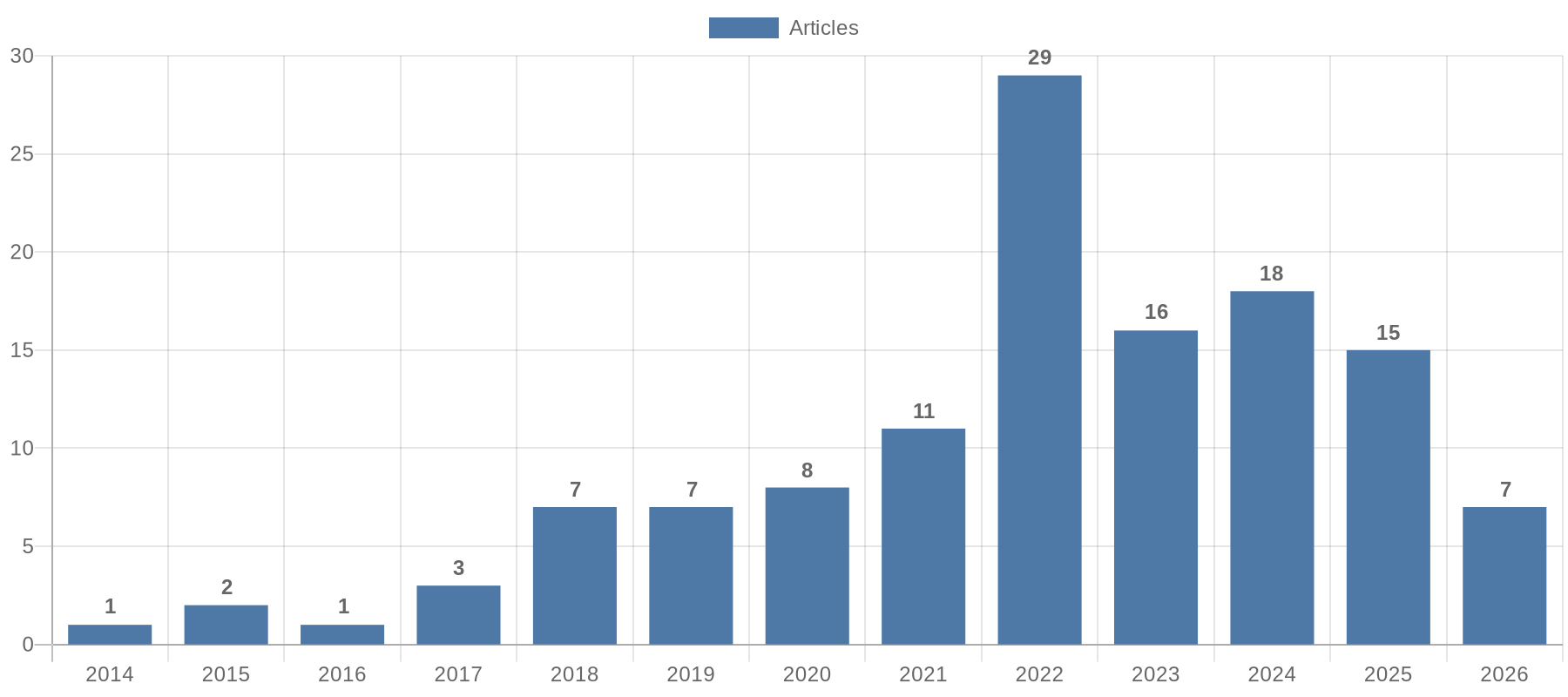
Online First: 81 article(s) • Page 3 / 7 Full archive (source) →
Showing: Cardiac & Vascular Health · Chat with this issue →
Cardiac & Vascular Health Cardiac & Vascular Health
PAD is not just a leg-artery disease — it is a powerful warning sign for future death, cardiovascular events, limb loss, and frailty. This review maps which signals matter most for prognosis, from MALE, polyvascular disease, diabetes and CKD to biomarkers, nutrition scores, exercise capacity, and machine-learning risk prediction.
Updated: 2026-05-09 • ID: peripheral-artery-disease-prognosis-20260504-121657-c7ca5b3c
Cardiac & Vascular Health Cardiac & Vascular Health
This review shows that PAD is not a niche vascular diagnosis but a massive, underrecognized global burden that concentrates sharply in diabetes, kidney disease, stroke, and other high-risk populations while often remaining clinically silent. The full read is worth it because it maps where PAD prevalence is truly highest, why reported rates vary so widely, and which patient groups should trigger much earlier ABI-based case finding.
Updated: 2026-05-09 • ID: peripheral-artery-disease-prevalence-20260402-211813-ec430229
Cardiac & Vascular Health Cardiac & Vascular Health
PAD is not just blocked arteries — this review shows it as a biologically complex disease driven by endothelial failure, oxidative stress, metabolic myopathy, mitochondrial dysfunction, and emerging signals from gut metabolites, extracellular vesicles, and non-coding RNA pathways. The full read is worth it because it maps where the strongest mechanistic evidence lies, which biomarkers may matter next, and which pathophysiologic signals could reshape future PAD diagnostics and targeted therapy.
Updated: 2026-05-09 • ID: peripheral-artery-disease-pathophysiology-20260308-215923-8ffb6594
Cardiac & Vascular Health Cardiac & Vascular Health
PAD is not just undertreated — it is systematically undertreated despite repeated signals that proper medication changes survival, cardiovascular risk, and limb outcomes. This review shows where the real gaps are, which therapies carry the strongest signal, and why better discharge and follow-up prescribing may be one of the most actionable opportunities in vascular care.
Updated: 2026-05-09 • ID: peripheral-artery-disease-medication-20260403-212905-3b5bca76
Cardiac & Vascular Health Cardiac & Vascular Health
This paper shows that PAD does not affect women and men in the same way: women are often treated less aggressively and face more perioperative complications, while men more often carry the burden of amputation, mortality, and severe limb outcomes. The full paper is worth reading because it makes clear where the true gender gap lies in PAD—not just in prevalence, but in diagnosis, treatment, and what happens after intervention.
Updated: 2026-05-09 • ID: peripheral-artery-disease-gender-20260303-223354-d77d7bd0
Cardiac & Vascular Health Cardiac & Vascular Health
This review shows that anticoagulation in PAD is not a simple “more is better” story: low-dose rivaroxaban plus aspirin delivers the clearest reduction in limb and cardiovascular events, but the benefit is tightly linked to patient selection and bleeding risk. The full read is worth it because it maps exactly where dual pathway inhibition is strongest, where full-dose or nonspecific anticoagulation may backfire, and how PAD changes the antithrombotic strategy in real-world settings like revascularization, VTE overlap, and atrial fibrillation.
Updated: 2026-05-09 • ID: peripheral-artery-disease-anticoagulation-20260129-172912-ac354ec8
Cardiac & Vascular Health Cardiac & Vascular Health
This paper shows that PAD risk is driven mainly by smoking and diabetes, but is also strongly shaped by age, hypertension, dyslipidemia, inflammation, and social disadvantage. The full paper is worth reading because it makes clear which factors matter most, which newer risk signals are emerging, and why PAD is still too often missed despite its major impact on limb loss and cardiovascular death.
Updated: 2026-05-09 • ID: pad-risk-factors-20260224-165647-c805251e
Cardiac & Vascular Health Cardiac & Vascular Health
This review shows that PAD bypass outcomes are driven less by the operation alone than by who the patient is going into it: dialysis, CKD, conduit choice, and post-operative management repeatedly shape survival, limb outcomes, and graft durability. The full read is worth it because it clarifies where bypass still holds its strongest advantage over endovascular therapy, which patients benefit most, and which risk signals should change decisions before and after surgery.
Updated: 2026-05-09 • ID: pad-bypass-surgery-20260309-202932-2b85bc4c
Cardiac & Vascular Health Cardiac & Vascular Health
PAD-related amputation is rarely caused by one factor alone: this evidence map shows how diabetes, tissue loss, kidney disease, delayed vascular assessment, undertreatment, and social inequality converge to decide who loses a limb. The full review highlights which therapies, warning signs, and limb-preservation pathways may reduce major amputation risk before the window for salvage is lost.
Updated: 2026-05-09 • ID: pad-amputation-20260501-182232-20fbe2d9
Cardiac & Vascular Health Cardiac & Vascular Health
The aim of this paper is to synthesize research findings on the risk factors for the development of mesenteric ischemia and the clinical, laboratory, and radiological predictors of mortality and intestinal necrosis in affected patients. The review utilises 213 original studies with 1362960 total participants (topic deduplicated ΣN). The evidence map suggests that mesenteric ischemia risk and prognosis are dominated by a recurring triad of systemic vulnerability, hemodynamic compromise, and markers of advanced bowel injury. Among the clearest signals, lactate thresholds above 2–3 mmol/L, SOFA v…
Updated: 2026-05-08 • ID: mesenteric-ischemia-risk-factors-20260224-125504-c40d2c54
Cardiac & Vascular Health Cardiac & Vascular Health
Surgery does not end when the operation ends: this review shows that across oncology, bariatrics, orthopedics, transplantation, and vascular care, postoperative medication adherence is often the hidden determinant of recurrence, complications, and survival. The full read is worth it because it separates where adherence reliably fails, which barriers drive that failure, and which interventions actually help keep patients on treatment after discharge.
Updated: 2026-05-08 • ID: medication-adherence-after-surgery-20251126-192700-c08385f4
Cardiac & Vascular Health Cardiac & Vascular Health
To synthesize current evidence regarding the clinical efficacy, biological mechanisms, and patient-centered outcomes of larval therapy in the management of acute and chronic wounds across human and animal models. The review utilises 94 original studies with 12244 total participants (topic deduplicated ΣN). Across the mapped evidence, larval therapy emerged most consistently as a rapid biological debridement strategy, with reported signals including a 92.3% wound-healing rate in post-revascularization ischemic wounds versus 18.2% with vacuum-assisted closure at one month, median free-range debr…
Updated: 2026-05-08 • ID: larval-therapy-20260429-160201-9407ba6d
© 2026 SAIMSARA Journal • Impressum • Published by ML in Health Science GbR